General Contracting Services
Demolition and Site Clearing in Lawton
Frederick's old hospital came down in the summer of 2025, according to a KLAW report, and the town had been without a hospital for roughly nine years. The Comanche County Hospital Authority is now building Memorial Health of Tillman County there, one of the healthcare systems projects in the region, with completion expected by the end of 2026 or early 2027. The demolition made room for something new, and that is the usual purpose: you take out what no longer works so the land can do a different job.
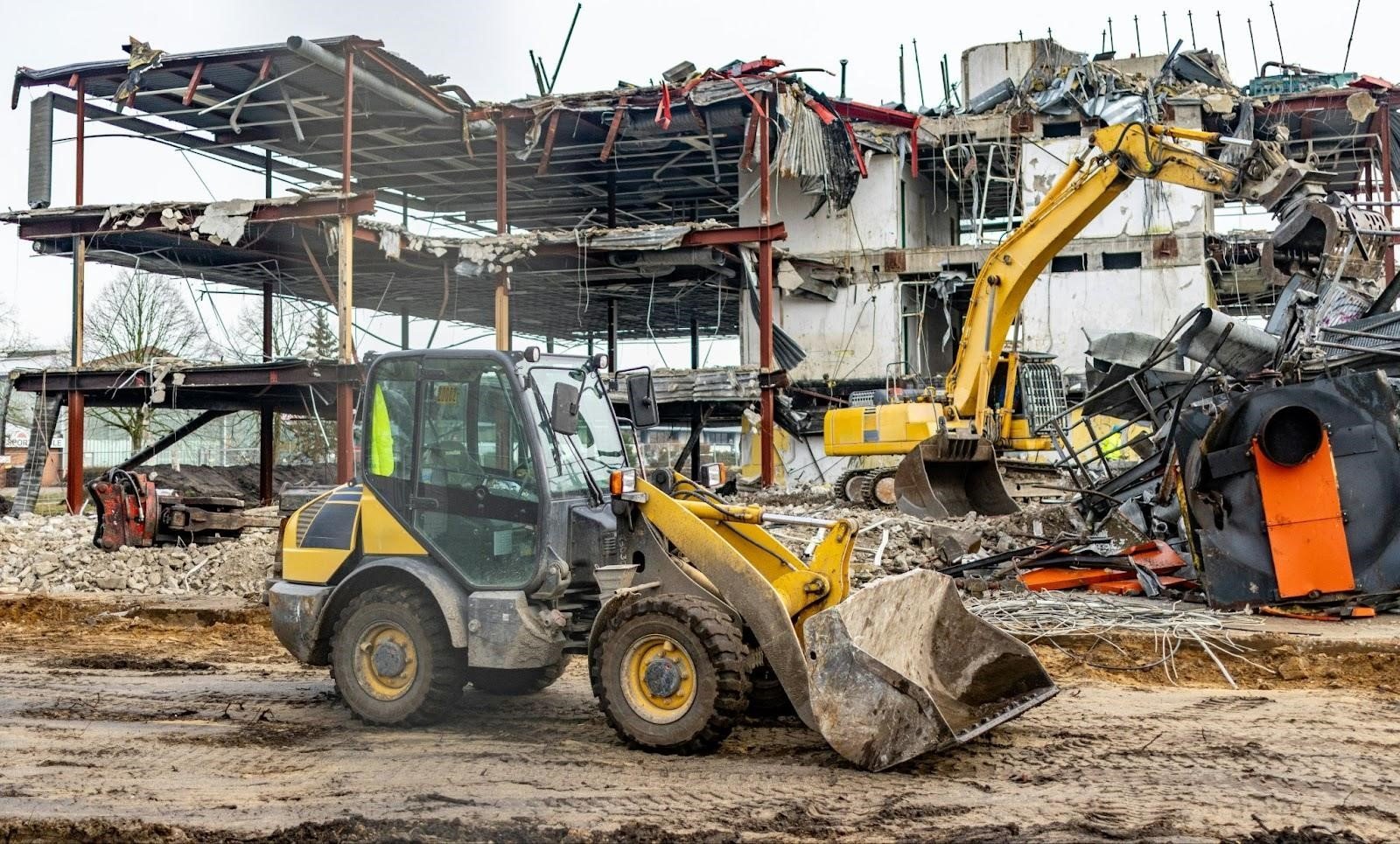
We perform selective and full demolition of commercial, institutional and industrial structures. That covers interior strip-outs for renovation, partial demolition where one wing is removed and the rest stays, full building demolition, slab and foundation removal, and site clearing. We pair demolition with the next phase of work, so the same team that clears the site can rough-grade it for what comes next.
Demolition looks simple, and it is not. The work is governed by what is inside the building, what is under it, what is next to it and what the regulators require before the first wall comes down.
Survey, utilities and sequence
Every demolition starts with a survey. We review drawings, visit the site, and identify structure type, material, utilities, adjacent buildings and access. Regulated materials, including asbestos-containing material, lead-based paint and universal waste such as fluorescent lamps and mercury switches, must be inventoried and removed before demolition begins. Licensed abatement contractors handle that work and the owner receives the clearance documentation.
Next we disconnect and cap utilities. Electric, gas, water, sewer, telecom and fire lines are shut off and capped at the street or main, and the utility company or city verifies when required. Then we plan the sequence: interior stripping, mechanical removal, structural takedown, foundation removal, backfill and site restoration. The plan is written, with a diagram of the work zones, exclusion zones and haul routes. Salvage and recycling are planned in advance. Concrete, brick and masonry can often be crushed for fill or base material, and steel goes to recyclers. Recycling reduces haul and disposal cost.
Falling material, dust and wind
Demolition is a hazardous activity. Falling material, dust, noise, trapped utilities and unstable structures can hurt workers and the public. Our safety plan includes a competent person on site, perimeter fencing, dust control with water, exclusion zones for the equipment swing, and protection for adjacent properties. Structural engineers review the takedown sequence on multi-story and complex structures, because removing the wrong member first can bring a building down early.
Wind adds a regional hazard. Southwest Oklahoma is known for gusty days, and a partly demolished wall is a sail. We stop exposed-wall work when the gusts rise, brace or take down vulnerable sections first, and watch the forecast. The National Weather Service Norman office's tornado table for Lawton includes an April 10, 1979 tornado that killed 3 and injured 100, so severe weather planning, including a shelter location and a stop-work rule, is part of every site plan.
Permits and former industrial sites
Demolition requires a permit from the local authority, and the permit often requires proof of utility disconnection, asbestos survey results and notification to environmental regulators before work begins. The City of Lawton Planning Department reviews permits and business licenses against the Zoning Code and Land Use Plan, and the city's Fire Prevention Division is involved when fire protection or hazardous materials are affected. In downtown Lawton, the architectural review committee's interests may apply when a building facade is part of the streetscape.
Some sites carry environmental history. Cyril, for example, had an oil refinery that employed 160 people until it closed in 1984 and later became a Superfund cleanup site, according to Wikipedia. We cite it as a reminder that former industrial sites can need environmental due diligence before demolition or excavation. A Phase I environmental site assessment, ordered by the owner, tells us what to expect, and a plan for contaminated soil or groundwater, if found, is made with the owner and the regulator. See also our permitting page.
What is underground and who is next door
The most common surprise in demolition is what is underground. Old foundations, tanks, septic systems, abandoned utilities and fill of unknown quality all appear. We probe and pothole when we can, and we pre-price removal of unforeseen items by unit. We ask for as-built drawings of the building and its utilities. The Cache Road corridor has been the subject of waterline and pavement work in recent years, so utility records there are a good starting point, and we compare them to what we find in the ground.
Neighbors are another. A demolition next to an occupied building needs vibration monitoring, dust control and protection of shared walls. If an owner is planning a vacant property such as a closed cinema or a mall, the renovation and adaptive reuse alternative should be priced alongside demolition. Sometimes keeping the shell is cheaper.
Abatement, utilities and turnover to the next trade
Schedule depends on the size, the hazmat work and permits. Abatement comes first and can take longer than the demolition itself. Utility disconnects depend on the utility company's response time, which we request at the start. Weather affects dust control, equipment work and hauling. We provide a schedule with those dependencies shown and hold weekly updates.
After demolition, we leave the site in the condition the next step requires: backfilled and compacted for a new building, rough-graded for grading work, or seeded and stabilized for erosion control. A cleared hospital pad, for instance, goes straight into hospital construction staging. Where the next step is a new foundation, we remove old footings fully and test the fill beneath them, so the new foundation is not placed on unknown material. We also provide disposal tickets and recycling reports so owners can document how debris was handled.
Tell us what has to come down
Send the address, the building description and what you plan to build next. We will survey the site, identify the permits and hazardous materials work, and return a price and a schedule. Use the quote form or call.
Common Questions
What permits are required for demolition in Lawton?
A demolition permit from the local authority is typical, along with proof of utility disconnection and asbestos survey results. We confirm the exact requirements with the city before scheduling work.
Do you handle asbestos and lead paint?
We coordinate licensed abatement contractors for regulated materials, because they must be removed before demolition by qualified workers. The owner receives the clearance documentation.
Can parts of a building be saved while the rest comes down?
Yes, with careful planning. We install shoring, protect the remaining structure and sequence removal to avoid damaging what stays. An engineer reviews the plan.
What happens to the debris?
Concrete and masonry are often crushed and reused as fill or base material, steel is recycled, and the rest is hauled to a permitted disposal site. We provide tickets and a recycling summary.
How do you protect neighboring buildings?
With protection, dust control, vibration monitoring when needed and a pre-demolition survey that documents existing conditions. Photos are taken before work begins.