
Building Types
Aircraft Hangar Construction in Lawton, Oklahoma
Forty-two single-engine airplanes, four twins, four jets and three helicopters are based at Lawton-Fort Sill Regional Airport, according to the state aerospace commission. That fleet mix is the starting point for any hangar discussion here. A single-engine owner wants a T-hangar or a small box. A jet operator wants a much wider door opening and a tail clearance that a light single never needs. The building follows the aircraft, and the aircraft vary a great deal.
A hangar is a big room with a door as big as one wall, a floor that handles fuel and de-icing runoff, and a fire protection system that is different from nearly any other building type. Getting those three things right matters more than any finish.
We build hangars as general contractors who understand airport rules: height limits near the runway, approvals from the airport sponsor, and a construction site that must keep taxiways and aprons safe while work goes on.
Airports we build near in southwest Oklahoma
The main field is Lawton-Fort Sill Regional Airport, with a concrete runway of 8,599 feet by 150 feet, an ILS approach, a control tower and fuel (100LL and Jet A1+). A September 2024 report said the City Council accepted an FAA grant for a preliminary engineering report on relocating Taxiway F, which does not meet FAA standards, and on expanding or repairing the terminal apron for military and other large aircraft. That planning suggests apron and taxiway work will matter to anyone siting a hangar there.
Smaller airports across the region have their own scale. Frederick Regional Airport occupies the former Frederick Army Air Field with three runways, and Halliburton Field at Duncan has a 6,326-foot runway and no control tower. Altus is a different class of field: a 2014 report described $56 million of KC-46 training facilities there, including new aircraft hangars. Each sponsor sets its own rules for leases and height. See Lawton-Fort Sill Regional Airport for our local notes.
Aerospace users and the sites built for them
The Airport Industrial Park is certified site ready with roads, all utilities and secure access to airport facilities for aerospace projects. That secure access is what separates an airside hangar parcel from a building across the road. Aerospace manufacturing is also growing locally: a $45 million investment announced in May 2025 for the west-side rail park includes a $23 million manufacturing facility, which the Lawton Economic Development Authority is building for its tenant.
Those developments point to hangar demand from corporate aircraft owners, flight training, maintenance providers and aerospace suppliers. Each needs a slightly different building. We discuss public sector and manufacturing owners side by side because both often use the same airport and the same approval path. Maintenance providers that also need shop and office bays sometimes look at flex and light industrial buildings next to the field.
Airport approvals, fire protection and building review
A hangar needs two kinds of approval. The airport sponsor, usually the city, reviews the lease, the location, the height and the effect on airfield operations, and the FAA may need notice of construction near the runway. Then the building permit review begins, with a complete plan set under the city checklist and fire protection review by the Fire Prevention Division. We start the sponsor conversation before design, since its answer can move the building.
Fire suppression is the most unusual item. Large hangars usually need foam or high-expansion systems, or specialized sprinkler designs, and the fire code sets requirements by aircraft size and fuel. Projects follow the building, fire and electrical codes the City of Lawton adopts and enforces; we confirm which codes govern the permit directly with Inspection Services. Only city-licensed contractors can request inspections.
Clear span, the door and the floor
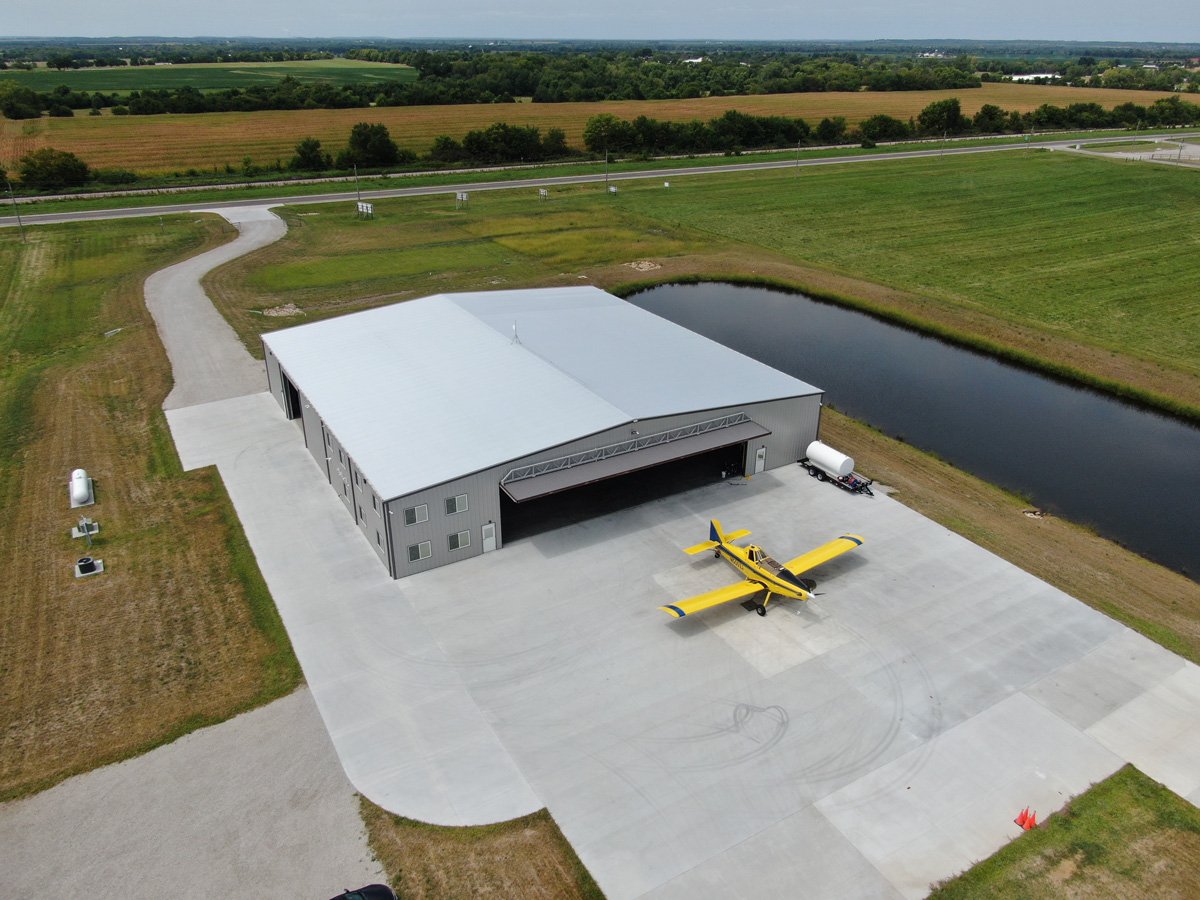
A hangar needs a long clear span with no columns where an aircraft will sit. That points to a rigid-frame metal building or a steel truss, and our pre-engineered metal building experience and the clear-span rigid frame service apply directly. The frame must be designed for the door loads and the wind pressures that act on a wall that is mostly opening.
The door is the most important component. Bi-fold, hydraulic and sliding doors each have different headroom, speed and maintenance needs. Hydraulic doors need a strong header and a tidy apron. The floor is sloped to drains that connect to an oil-water separator, and the concrete is sealed to resist fuel. We pour the slab to a flatness that allows aircraft tugs to move freely. Foundations around the door track are detailed carefully; see concrete foundations.
Building beside an active airfield
Construction near a runway is governed by airfield safety plans. Cranes and tall equipment can penetrate protected airspace, so we submit their heights and locations in advance. Vehicles and workers on the airfield need approved routes, escorts and radio procedures. Fenced work zones keep debris off pavement, because a loose bolt on an apron can damage an aircraft engine.
We also protect the building process from the weather. Lawton had golf-ball hail and gusts of 65 to 70 mph in June 2023, and the tornado record for Lawton is long. Hail on an aircraft is a serious loss, which is a main reason owners build hangars. We design the roof, door seals and anchor bolts at the foundation to the engineer's wind loads, and we discuss hail-resistant roof surfaces with the owner's insurer.
From lease approval to aircraft in the building
The slowest part is often approval, not construction. Lease terms, FAA notice, a site plan and a utility agreement can take months. Once they are in place, a small to mid-size hangar can move quickly from foundation to enclosure. We order the door and frame early, since the manufacturer's lead time governs the erection date, and the door must be set to tolerances that cannot be corrected on the final day.
We also plan the apron and taxilane connections as part of the schedule. A hangar is not usable until aircraft can get in and out of it, so paving, markings and lighting are finished before the final inspection. For pavement scopes, see dock aprons and heavy paving, which uses similar methods for heavy loads.
Tell us the aircraft
Send the aircraft type, wingspan, tail height and the airport you prefer. We will review approvals and site constraints, then give you a door, structure and fire protection plan with a schedule that starts with the sponsor approval.
Common Questions
What size door do I need?
It depends on the largest aircraft you plan to house, including wingspan and tail height, with clearance on each side. A single-engine plane fits a much smaller door than a business jet. We take dimensions from the manufacturer's data, add a margin and then choose between bi-fold, hydraulic and sliding doors based on cost and headroom.
Do I need foam fire suppression?
Often, but it depends on the building size, the aircraft type and the fire code. Smaller hangars may use sprinklers, while large ones typically need foam or high-expansion systems. The Fire Prevention Division reviews the design. We bring a fire protection engineer in early so the system and the structure are designed together.
Who approves a hangar at the Lawton airport?
The airport sponsor reviews the lease, location and height, and the FAA may require notice. Then the city reviews the building permit with its required documentation checklist. These are separate processes, and each takes time. We start with the sponsor, then finalize the drawings, then submit for the permit.
Can a hangar be built near a runway while the airport operates?
Yes, with an airfield safety plan. We submit crane heights, mark work areas, use escorts for vehicles and keep pavement free of debris. Work may be restricted during certain operations. We schedule deliveries and concrete pours around the airport's hours and the owner's flight activity.
How do I protect aircraft from hail and wind?
A closed hangar is the simplest protection. Lawton had golf-ball hail in June 2023, and tornadoes have struck the area before. We design the structure for wind, seal the doors well and discuss roof materials with the insurer. Owners should still plan to tie down or relocate aircraft when severe storms are forecast.