
General Contracting Services
Truck Courts and Dock Aprons in Lawton
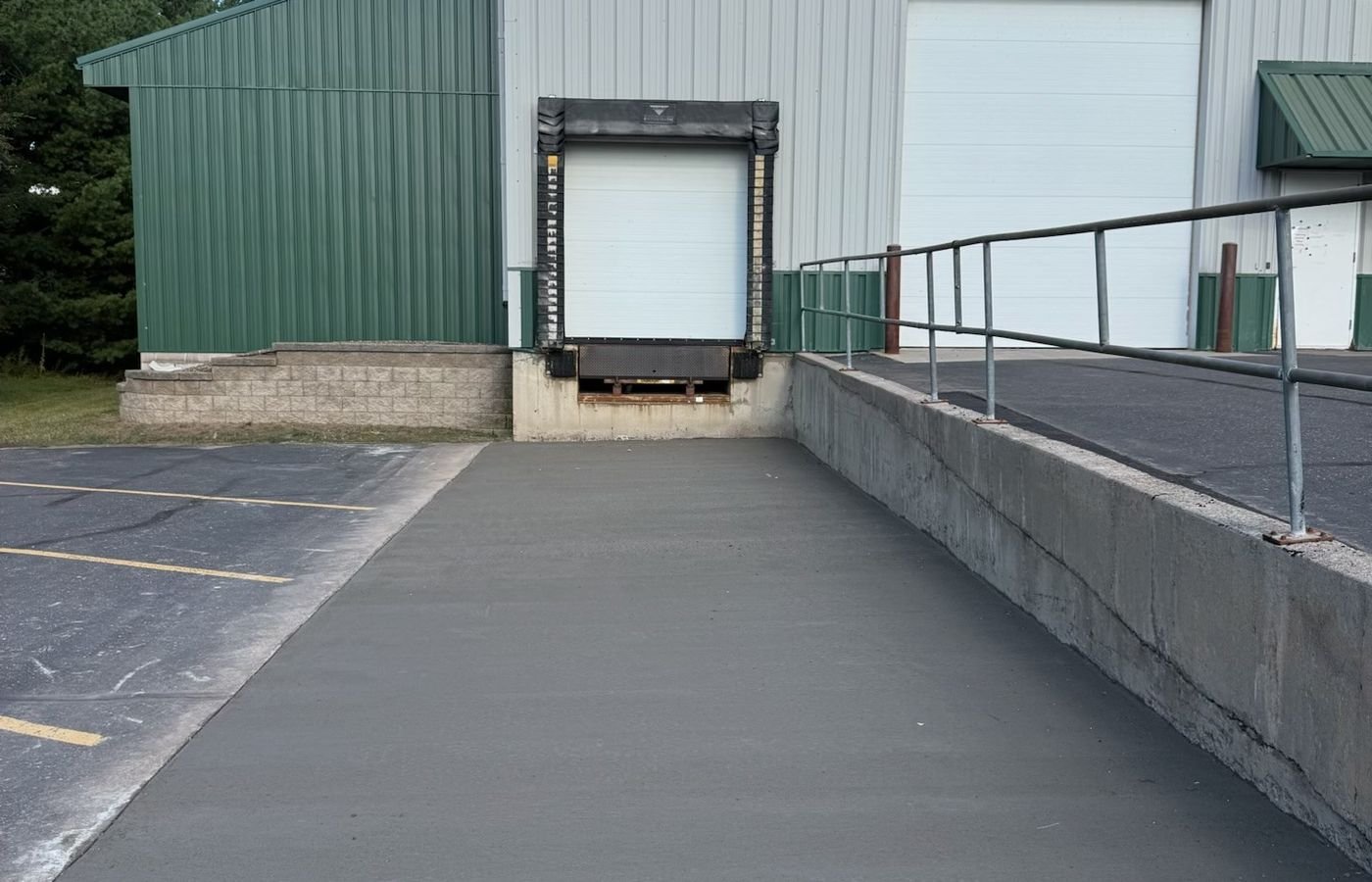
A loaded trailer parked on its landing gear puts a point load on the pavement that no passenger car lot ever sees. Multiply that by dozens of dock doors and a day of backing, braking and turning, and the truck court becomes the hardest-working surface on a distribution or manufacturing site. We build truck courts and dock aprons to carry that load: thick, doweled concrete in the dock zone, heavy-duty pavement in the drive lanes, and enough slope and drainage that water does not sit in front of a dock leveler.
The geometry matters as much as the concrete. Tractor-trailers need turning radii that most standard site plans do not provide unless the designer planned for them. We review the truck court layout against the turning templates the owner's carriers use, and we flag pinch points before the forms are set. A slab that is perfectly poured in the wrong shape is still a problem.
Our work here connects directly to the building. Dock height, pit depth, apron slope and trailer approach all have to line up with the floor inside, which is why we think of the court and the warehouse floor as one design problem.
Interstate, rail and where trucks go
Lawton sits on Interstate 44, known on this stretch as the H. E. Bailey Turnpike, with exits in Comanche County at SH-36 near Geronimo, at US 62 and US 277 near Elgin and Apache, at US 277 near Fletcher and Elgin, and at Whitfield Road. Trucks serving the area come off those ramps and head for the industrial parks. The Airport Industrial Park in south Lawton sits at Highway 277 and I-44; the Oklahoma SW Rail Industrial Park on the west side has the Stillwater Central Railroad running through it, with tenant rail spurs built to suit.
That combination of highway and rail changes what a truck court needs. A site with a rail spur may run trucks and rail cars in the same yard, which calls for crossings, bollards and clear sight lines. A site on the interstate side may handle a high volume of through trucks with short dwell times. We design our scope questions around the actual operation and not a generic standard. Related work for truck terminals and cross-docks follows the same logic.
Concrete, asphalt or both
Most commercial truck courts and dock aprons in this region end up as either concrete or heavy-duty asphalt, and the right answer depends on traffic, budget and maintenance plans. Concrete holds up better under the high point loads of parked trailers, resists the fuel and oil spills common near docks, and lasts longer between major repairs. Asphalt costs less up front, can be reopened and patched quickly, and is often used in drive lanes where the trailers keep moving.
Many owners combine them: concrete aprons in front of the doors and in staging areas, asphalt in the circulation lanes. Where the two meet, we detail the transition so it does not trip a pallet jack or tear up under braking. The pavement section, base thickness and subgrade treatment come from the civil and geotechnical engineers, and we build to their section. When they have not specified a section for a new owner's project, we recommend that they do, because trucks are unforgiving. Our parking lot construction page covers the lighter-duty lanes that sit beside these courts.
Plan review and highway access
The City of Lawton's Planning Department reviews development plans, building permits and business licenses against the Zoning Code and Land Use Plan, and the City's Fire Prevention Division enforces fire codes and reviews plans through the permitting process. For a truck court, that review typically touches access, turning movements, lighting, screening, stormwater and fire lane widths. We have found that questions about truck turning and fire apparatus access are where plans come back with comments, so we like to review them with the design team before submittal.
Highway access may bring another reviewer. The Oklahoma Department of Transportation held an April 2024 public meeting on a new US-62 interchange and an extension of Goodyear Boulevard from Cache Road to US-62, intended to improve mobility for the west industrial area. Owners with property near that corridor should watch those plans, since new access can change how trucks reach the site. The approvals sequence is covered in more detail on our permitting and entitlements page.
Pits, joints and curing
Dock pits, trench drains, and apron slopes are placed in a sequence that starts with the building footings. Dock leveler pits are cast with the slab and need to be accurate to a fraction of an inch, because the leveler manufacturer's frame sets the door height. Apron slabs are placed after the building is dried in, with joints laid out to match the door spacing so that trailers do not park over a joint. Reinforcement, dowels and edge details are placed to the engineer's drawings.
Curing is more important here than in a parking lot. A concrete apron that dries too quickly in west Oklahoma wind will craze and scale, and a surface that scales is hard to repair. We use curing compound or wet curing as the specification requires, and we protect new aprons from trucks until the concrete reaches strength. Owners who plan their move-in date around the first trailer should know that the apron may be the last surface to open.
What a better apron costs
Truck court cost follows the pavement section, the area and the amount of site grading beneath it. Doweled joints, thick sections and high-strength mixes raise the price per square yard, but they reduce the maintenance bill later. The cost of a failed apron, which means shutting down docks to demolish and replace the slab, is much higher than the cost of building it right.
We provide alternates for different sections and finishes so owners can compare life-cycle cost and not only first cost. For multi-building parks, we recommend building shared drive lanes first and apron areas as buildings arrive, which is a practical form of phased construction. Our work with logistics and distribution users often includes striping, wheel stops, bollards and signage so the court operates safely on day one.
Send us the site plan and the fleet
Give us the truck types you expect, the number of docks and the site plan. We will check the turning geometry, price the pavement options and give you a calendar. Call us or use the quote form.
Common Questions
Should our dock apron be concrete or asphalt?
Concrete is usually the better choice in front of the doors, where trailers park and landing gear loads concentrate. Asphalt can serve in circulation lanes. We price both so you can see the first cost and expected maintenance.
How wide should the truck court be?
The depth depends on trailer length, the number of dock doors and whether trucks back in from one side or two. Common designs run 120 to 185 feet from the building face, but the owner's truck fleet and the civil engineer determine the right number.
Do rail spurs affect the truck yard design?
Yes. Crossings, signals, track clearance and sight lines for drivers have to be designed into the layout. The railroad that serves the site may also have its own requirements for work near the track.
How soon can trucks use a new apron?
After the concrete reaches its specified strength, often a week or more depending on the mix and the weather. We confirm with cylinder breaks before opening the area to heavy traffic.
What is the usual cause of apron failure?
Poor subgrade support, thin sections, missing dowels and uncontrolled drainage are the usual causes. Most can be avoided with a proper geotechnical report, a well-compacted base and careful joint design.