
Service Areas
Building Along the Interstate 44 Corridor
Freight buildings are chosen by exit, and the exit decides what the building has to be. Interstate 44, which the state turnpike authority operates here as the H. E. Bailey Turnpike, is the route trucks use into and out of Lawton, and we build warehouses, truck terminals and light industrial shells with that road in mind: where the trailers enter, where they queue, how they turn and how long it takes a driver to get back to the ramp.
Wikipedia lists the turnpike at 86.4 miles, opened April 23, 1964 and signed as Interstate 44 from 1982 onward, with exits in Comanche County at State Highway 36 for Geronimo and Faxon, at US 62 and US 277 for Elgin and Apache, at US 277 for Fletcher, Elgin and Sterling, and at Whitfield Road for Fletcher, Cyril and Sterling. That list reads like a menu of sites. Each exit has a different mix of land, utilities and existing development, and a builder who knows the differences can save an owner months of searching. We walk the exits, check the access and the utility availability, and tell owners which sites are ready and which are speculative.
Road work that changes the haul route
The road itself is being rebuilt, in stages. A March 2025 notice from the Oklahoma Turnpike Authority said I-44 was narrowed to one lane each way in Comanche County between mile marker 62 and near US-277 toward Fletcher for shoulder repairs and guardrail replacement, under an $8.5 million contract, with ramps staying open. A February 2026 release described an $11.5 million pavement reconstruction from Randlett to Walters, mile markers 5 to 20, running through late summer 2026, plus a segment near State Highway 36 at Geronimo. An April 2025 report said the authority is investing over $50 million over five years in the turnpike because it is more than 60 years old, including full repaving between mile markers 20 and 30 south of Lawton.
For a builder with steel, precast or aggregate arriving on trucks, a lane reduction means slower delivery. We watch the authority's notices and plan deliveries outside the narrowest weeks. We also advise owners that a site near a construction zone may see changed truck patterns during the work, and a better road afterward.
Truck terminals, warehouses and flex space
A truck terminal is a lot with a building attached. The pavement, the turning radius and the fueling and maintenance areas are the heart of the project, and the building supports them. Our page on truck terminals and cross-docks covers the dock layouts and the heavy concrete we use. A warehouse is the reverse: the building is the project, and the yard supports it. The page on warehouses sets out that approach.
Flex and light industrial buildings suit the smaller exits. A 20,000 to 40,000 square-foot building with a few dock doors and a drive-in door can serve a distributor, a contractor or a repair business, and it can be built with a pre-engineered metal frame at a modest cost. Owners comparing frame systems can read about pre-engineered metal buildings.
Pavement and yard work
Truck pavement is the part owners underestimate. A trailer that is parked loaded concentrates weight on small landing gear pads, and a turning truck scrubs the surface. Concrete is the usual answer at dock aprons and turning areas, with asphalt acceptable for lighter automobile parking. Subgrade preparation, thickness, joint spacing and dowels are the details that decide whether a yard lasts or has to be repaired within a few years.
We manage site grading and concrete paving as one scope when the owner wants a single point of responsibility. Drainage is part of the same package: swales, inlets and detention have to take heavy rain without flooding the dock. See truck courts and dock aprons and mass grading for the full scope.
Who builds on the interstate
Distribution operators, manufacturers, equipment dealers and trade contractors all look for frontage on or near the interstate. The development corporation's Airport Industrial Park sits at Highway 277 and I-44 in south Lawton, and its distribution warehouse project of more than $16 million and 110,000 square feet is directly off I-44. The Airport Industrial Park page covers that site in detail.
Developers who hold land at other exits face a different question: whether to build speculatively. A shell building on a visible interstate parcel can attract tenants, but only if utilities, access and zoning are in place. Commercial real estate developers can ask us for a quick feasibility estimate that shows the cost of the shell, the site work and the access improvements, and can test it against the rents they expect.
Planning around interchange limits
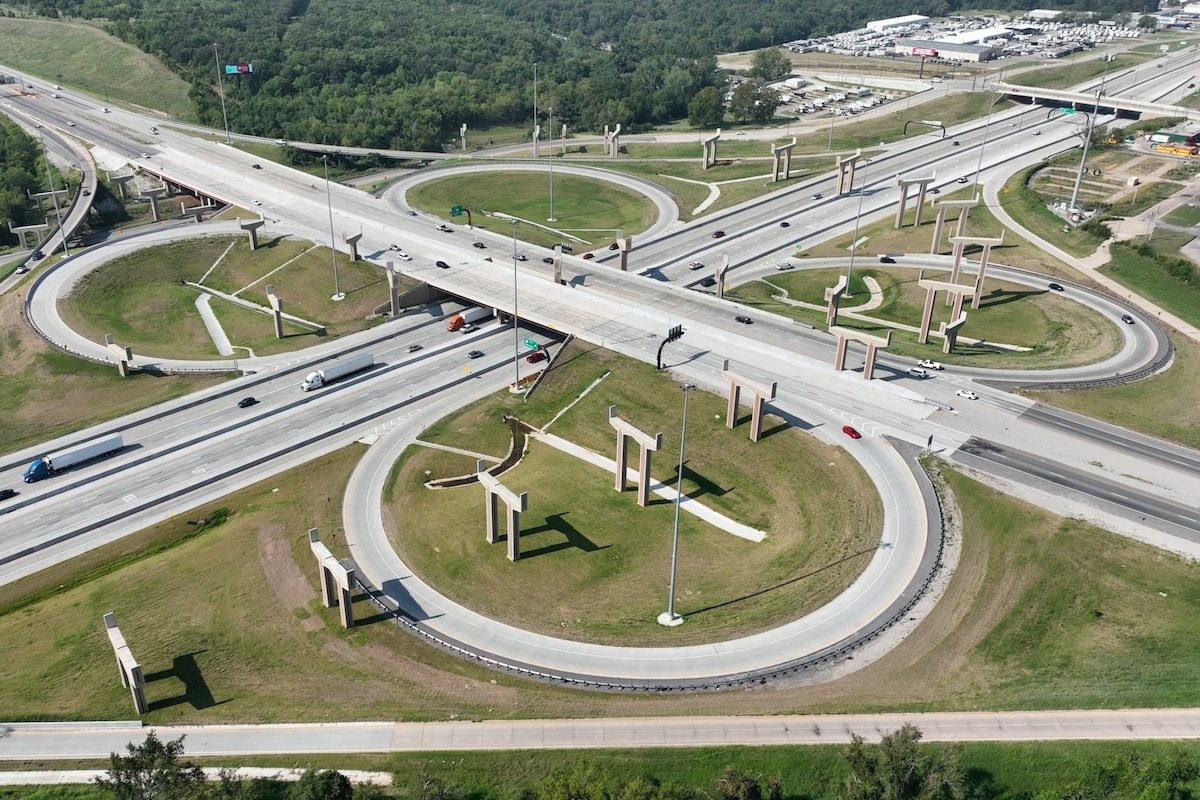
The Whitfield Road exit is listed as an incomplete interchange planned for conversion to a full interchange. An incomplete interchange limits which directions traffic can enter and leave, and an owner on that road should ask the turnpike authority about its plans before choosing a site. Timing of that conversion is not something we can promise, so we design site access to work under current conditions and, if possible, under future ones.
The same caution applies to construction traffic. We prepare a haul plan that identifies which ramps delivery trucks will use, where they will stage and how they will turn onto the site. For a project in Fletcher or Elgin, the plan accounts for the two-lane roads that connect the exits to the site. Large loads such as steel or precast panels may need route approval, and we apply for it early.
If a site sits near a turnpike ramp, we also look at noise and stormwater from the road. Runoff from a paved road shoulder can flow onto a neighboring parcel, and an owner who builds at a low point may inherit it. Grading the site to catch and move that water is a modest cost when planned, and a large one when added after the first heavy rain.
Choose the exit, then the building
Tell us the use, the truck count and the region you want to serve. We will compare exits, price the site and building, and show you the schedule.
Common Questions
Which exit is best for a warehouse?
It depends on utilities, land, zoning and the traffic pattern you need. Exits closer to the city tend to have more services, while others have lower land cost. We evaluate each with a short list of criteria and report on it.
Will turnpike construction slow my project?
It can slow deliveries during lane reductions. We follow the authority's notices and schedule deliveries accordingly. The notices have said ramps stay open during some of these projects.
What is an incomplete interchange and why does it matter?
It is an interchange where some turning movements are missing. A truck-dependent business may find that one direction requires a longer route. Ask the turnpike authority about plans before buying land.
Is concrete or asphalt better for a truck yard?
Concrete is usually better at docks and turning areas, where loads are concentrated. Asphalt can work in lighter areas. We price both and show the life-cycle difference.
Can you build near the turnpike right of way?
Yes, with setbacks, drainage approvals and access permits from the authority or the state. We apply for those early since they can affect the site plan.